Lord Jesus Christ.
Son of God.
Have mercy on me.
A sinner and saint.
Saved.
By grace.
Through faith.


Lord Jesus Christ.
Son of God.
Have mercy on me.
A sinner and saint.
Saved.
By grace.
Through faith.
In the long and quiet history of Christian devotion, some of the most helpful prayers are the simplest. They are the ones that steady our hearts and remind us of who God is and who we are before Him.
One such prayer, which builds carefully on a foundation laid centuries ago, is this one. We might call it the Sinner and Saint Prayer:
Lord Jesus Christ.
Son of God.
Have mercy on me.
A sinner and saint.
Saved.
By grace.
Through faith.
You may notice a tension in the final lines. How can one be a "sinner" who needs mercy and, at the same time, be a "saint"? The answer to that question reveals the very heart of the Christian faith. To understand the comfort this prayer offers, let's first look at its ancient and hallowed beginnings.
The first lines of this prayer are not new: "Lord Jesus Christ. Son of God. Have mercy on me." They form the revered Jesus Prayer, a devotion that has been a cornerstone of Christian spirituality since the earliest days of the Church. It is a prayer woven directly from the words of Scripture.
For centuries, especially in the quiet of monasteries, Christians have repeated this simple prayer to draw near to God. It is a prayer of complete reliance. It teaches us to see Jesus as Lord, to see ourselves honestly as sinners, and to know that our only hope is in His bottomless mercy. This is the right and proper place for every Christian prayer to begin.
The Sinner and Saint Prayer cherishes this ancient foundation. It keeps the humble posture and the heartfelt plea for mercy. But it then adds crucial closing lines that bring the full comfort of the Gospel to bear on our hearts: "a sinner and saint, saved by grace through faith."
These lines do not erase what comes before. Instead, they speak a word of profound assurance. They answer the quiet, anxious question that can linger in a sinner's heart: "In spite of my failings, what is my true standing before God?"
Let's gently unpack the weight of these final phrases.
And here we find the deep pastoral value of this prayer. It helps us hold two foundational truths together, truths that must always be kept in balance for a healthy spiritual life:
This is the beautiful paradox of the Christian life. Martin Luther described it as being simul justus et peccator—simultaneously righteous and a sinner.
This prayer gives us the words to express that reality. It keeps us from two common spiritual dangers: despair, by forgetting the victory Christ has won for us, and pride, by forgetting our daily need for grace. The prayer's humble plea for mercy keeps us returning to the foot of the cross, where we belong.
In a few short lines, this prayer allows us to bring our whole selves before God—our failures and our faith, our sin and our salvation. It is a prayer of honest confession that leads directly to joyful confidence, resting entirely on the finished work of our Lord Jesus Christ.
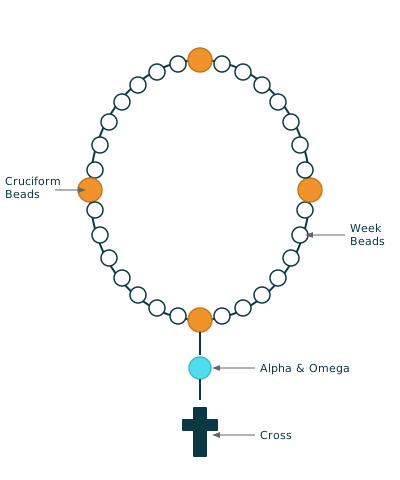
These prayer beads provide a tactile, meditative way to pray. Move clockwise through the beads, allowing the rhythm of repetition to quiet your heart and focus your mind on Christ.
In the Name of the Father and of the Son and of the Holy Spirit. Amen.
Heavenly Father, into Your hands I commend my body, soul and spirit
(and all things).
Help me be still
(that Your Spirit may intercede and guide my prayer).
Lord Jesus Christ.
Son of God.
Have mercy on me.
A sinner and saint.
Saved.
By grace.
Through faith.
Into Your hands I commit my spirit.
The Lord's Prayer.